Catarg: A Script Handwritten Font for Vintage-Inspired Branding
It was 10 a.m. on a rainy Tuesday, and I was holding a freshly printed batch of candle labels for a local maker I consult with — soft ivory kraft paper, minimalist botanical line art, and a handwritten font that just… didn’t land. Too stiff. Too digital. Too much like a font you’d find in a free Google Fonts dropdown. That’s when I swapped in Catarg. Within five minutes, the label felt warmer, more intentional — like something you’d find tucked into a Parisian apothecary or pressed between the pages of a well-loved journal. That’s the quiet power of a truly natural script handwritten font.
Catarg for Candle Labels and Handmade Product Packaging
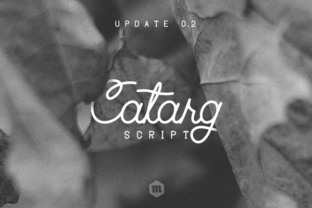
Catarg is inspired by traditional script lettering that typically is used in vintage-themed designs — think inked flourishes, subtle contrast between thick and thin strokes, and organic rhythm that mimics real pen-on-paper movement. It’s not overly ornate or fussy, which makes it perfect for small product labels where space is tight but personality matters. I tested it on 1.5-inch round stickers for soy candles (vanilla lavender, amber moss, sea salt sage), and the way the letters flow together — especially in short phrases like “hand-poured” or “small batch” — gave each jar immediate warmth and authenticity. As a fonts choice for physical packaging, Catarg works best at sizes 14–24 pt for body text and 28–48 pt for titles. Just avoid using it below 12 pt on printed materials — the delicate joins and fine hairlines start to blur on kraft paper or matte finishes.
Catarg for Café Menus and Local Business Signage
When a neighborhood café asked me to refresh their laminated menu board and takeout bag stamp, I reached for Catarg again — this time pairing it with a clean, airy sans serif (like Poppins Light) for supporting text. Why? Because Catarg shines as a display font: expressive, inviting, and inherently human. It doesn’t scream — it leans in. On a chalkboard-style menu, it evokes craft and care without looking costumed or theme-park-y. For signage, I used only uppercase lettering in Catarg for section headers (“Pastries,” “Specialty Drinks,” “Seasonal Favorites”) and kept descriptions in the sans serif. That balance gave the whole board visual hierarchy *and* emotional resonance — customers lingered longer, and staff reported more questions about the “story behind the menu.” As a script handwritten typeface, Catarg isn’t meant for long paragraphs — but for short, high-impact moments? It’s pure brand polish.
Catarg for Wedding Invitations and Elegant Branding
A friend who runs a small wedding stationery studio sent me a mockup using Catarg for envelope addressing and ceremony program titles. Instant upgrade. What makes Catarg special in this context isn’t just its vintage charm — it’s how naturally it pairs with classic serif fonts (think Playfair Display or Cormorant Garamond) and textured papers. The slight irregularity in stroke weight and baseline gives it breathing room next to formal typography, so it feels curated rather than chaotic. Since Catarg is a premium fonts option designed for real-world use, it includes standard ligatures and alternate characters — I swapped in the swash “&” and the elegant “y” tail for her “Mr. & Mrs.” line, and it added subtle distinction without overcomplicating production. For print-heavy projects like invitations, always confirm your file format supports OpenType features (OTF is ideal), and double-check commercial licensing before sending files to the printer.
Catarg for Instagram Templates and Digital Shop Banners
For social media, Catarg works beautifully — but with one caveat: use it sparingly and strategically. I built a set of Instagram story templates for an online herbal apothecary using Catarg only for headline text (“New Arrival,” “Limited Batch,” “Just Restocked”) layered over muted linen textures. Because it’s a script handwritten font with strong visual character, even at 36–48 pt on mobile screens, it held clarity and charm. No pixelation. No awkward spacing. Just warmth that stopped scrollers mid-feed. For website banners or Etsy shop headers, keep text short and centered — Catarg loves breathing room. Avoid stacking multiple lines of dense copy; instead, let it anchor one powerful phrase while your sans serif or serif handles the rest. And yes — it’s fully compatible with Canva, Adobe Express, and Figma, as long as you’ve installed the OTF or TTF version locally.
Catarg for Thank-You Cards and Small-Business Customer Touchpoints
The final test? Handwritten-style thank-you cards for a ceramicist’s holiday orders. We printed Catarg in deep charcoal on cream cotton stock — not as a full sentence, but just the first name (“Thank you, Maya”) followed by a tiny heart glyph. Simple. Personal. Unmistakably handmade-feeling, even though it was printed. That’s the magic of a thoughtfully chosen script handwritten font: it bridges the gap between scalable design and human connection. For these micro-moments — the card tucked into a box, the sticker on a parcel, the banner above a Shopify collection — Catarg doesn’t shout “look at my branding!” It whispers, “I made this with care.” And in today’s crowded digital marketplace, that whisper often carries further than any bold claim.
If you’re building or refining a small business identity — whether you sell candles, pastries, skincare, ceramics, or coaching — Catarg is more than a fonts download. It’s a consistency tool, a tone-setter, and a quiet signal that you value detail, authenticity, and timeless craft. Inspired by traditional script lettering that typically is used in vintage-themed designs, Catarg delivers a natural hand lettered feel without sacrificing polish — and that rare balance is exactly what helps small brands stand out, feel familiar, and earn trust — one beautifully set word at a time.